Canterbury Cathedral
Mother church of the Anglican Communion, site of Becket's martyrdom.

via Wikipedia: Canterbury Cathedral · see source
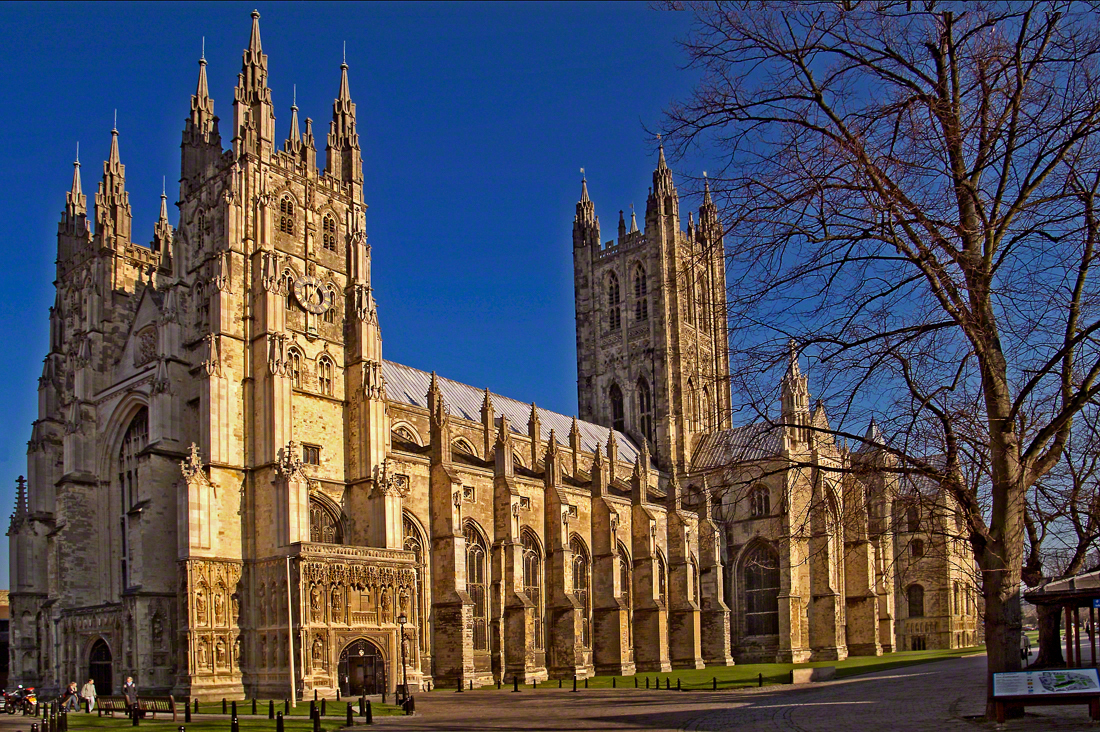
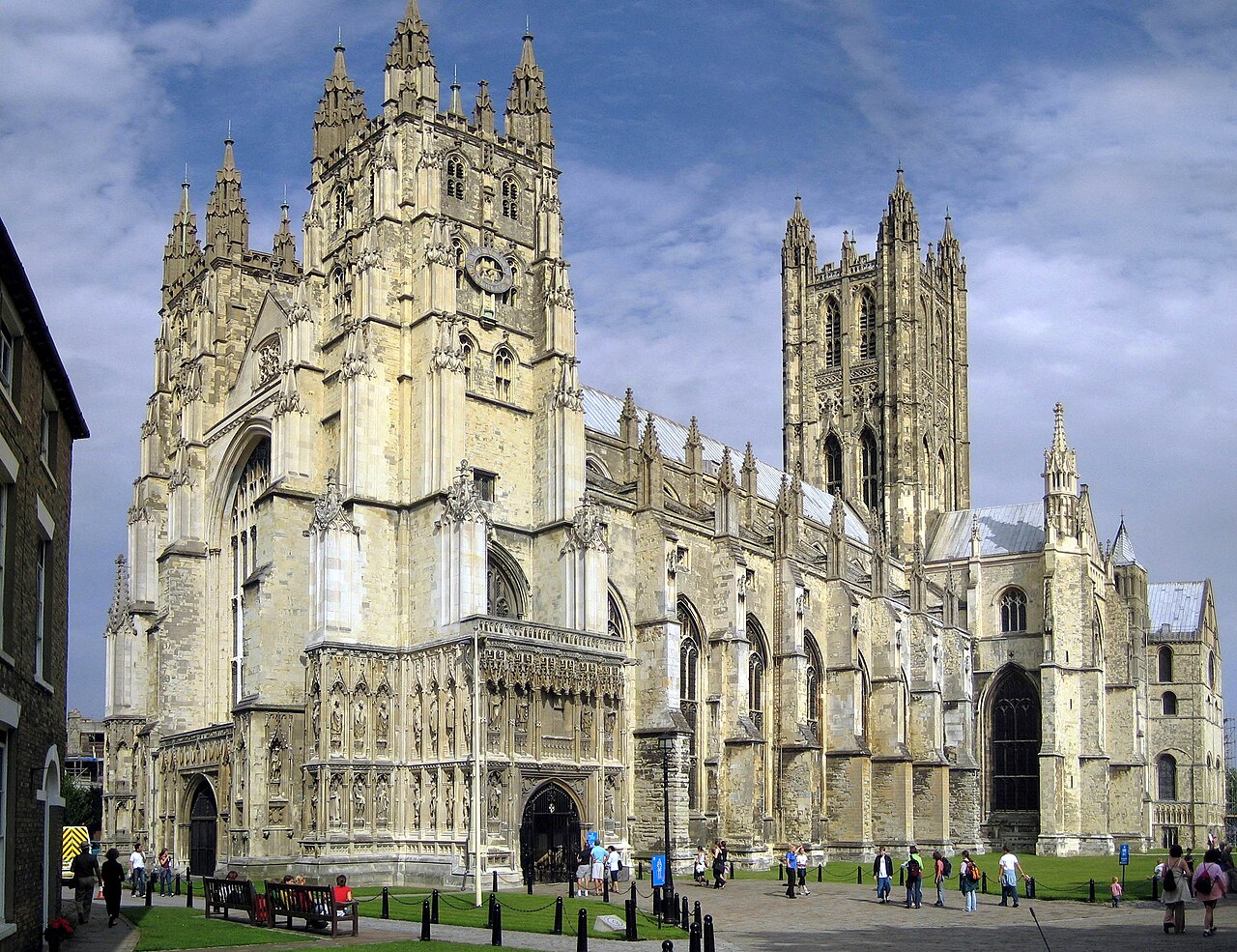
Canterbury Cathedral is the cathedral of the archbishop of Canterbury, the spiritual leader of the Church of England and symbolic leader of the worldwide Anglican Communion. Located in Canterbury, Kent, it is on the site of one of the oldest Christian structures in England and forms part of a World Heritage Site. Its formal title is the Cathedral and Metropolitical Church of Christ, Canterbury.
- Founded
- 597
- Location
- Canterbury, Kent, England
- Denomination
- Church of England / Anglican Communion
- World Heritage Site
- Yes
- Notable Event
- Murder of Thomas Becket (1170)
- Architectural Style
- Norman and Gothic
Lore & Background
The cathedral was founded in 597 by Augustine, who led the Gregorian Mission to convert the Anglo-Saxons. It was completely rebuilt between 1070 and 1077 under Norman archbishop Lanfranc. The east end was greatly enlarged at the beginning of the 12th century and largely rebuilt in the Gothic style after a fire in 1174, with significant eastward extensions to accommodate the flow of pilgrims visiting the shrine of Thomas Becket, the archbishop murdered in the cathedral in 1170. The Norman nave and transepts survived until the late 14th century, when they were demolished to make way for the present structures. Before the English Reformation, the cathedral was part of a Benedictine monastic community known as the Priory of Christ Church, Canterbury, as well as being the seat of the archbishop.
Reader's Guide
Canterbury Cathedral is significant as the seat of the archbishop of Canterbury, the spiritual leader of the Church of England and symbolic head of the worldwide Anglican Communion. Its history spans from its founding in 597 through the Norman Conquest, the murder of Thomas Becket in 1170, and subsequent Gothic rebuilding. The cathedral became a major pilgrimage site after Becket's martyrdom, which drove architectural expansions and increased its wealth. It forms part of a World Heritage Site along with St Augustine's Abbey and the Church of St Martin. The cathedral's fabric reflects layers of Anglo-Saxon, Norman, and Gothic construction, and its crypt survived the 1174 fire. The Chair of St Augustine, used for enthroning archbishops, may date from the Norman period, with its first recorded use in 1205.
Did You Know?
- The cathedral was founded in 597 by Augustine, who led the Gregorian Mission to convert the Anglo-Saxons.
- Archbishop Thomas Becket was murdered in the north-west transept on Tuesday 29 December 1170 by knights of King Henry II.
- The Chair of St Augustine, used for enthroning archbishops, may date from the Norman period, with its first recorded use in 1205.
- The cathedral was part of a Benedictine monastic community known as the Priory of Christ Church, Canterbury, before the English Reformation.
- The 1993 excavations beneath the present nave revealed foundations of an Anglo-Saxon building constructed across a Roman road.
Origins & the Gregorian Mission
Christianity's presence in Britain stretches back to the early third century, with Tertullian referencing it as early as 208 AD and Origen mentioning it in 238 AD. By 314, three Bishops from Britain attended the Council of Arles. When Roman life in Britain ended during the first three decades of the fifth century and heathen Anglo-Saxons arrived, Christian life in the east was disrupted, though textual sources suggest Christian communities survived in Western Britain during the fourth, fifth, and sixth centuries. In 596, Pope Gregory I ordered Augustine, the abbot of St Andrew's Benedictine Abbey in Rome, to lead the Gregorian Mission to convert the Anglo-Saxons. According to the writings of the later monk Bede, these missionaries gained permission from the Kentish king to restore several pre-existing churches. Augustine then founded Canterbury Cathedral in 597 and dedicated it to Jesus Christ, the Holy Saviour. He also founded the Abbey of St Peter and Paul outside the city walls, later rededicated to St Augustine himself, which for many centuries was the burial place of successive archbishops. The abbey is part of the World Heritage Site of Canterbury, along with the cathedral and the ancient Church of St Martin.
A Cathedral Rebuilt Again and Again
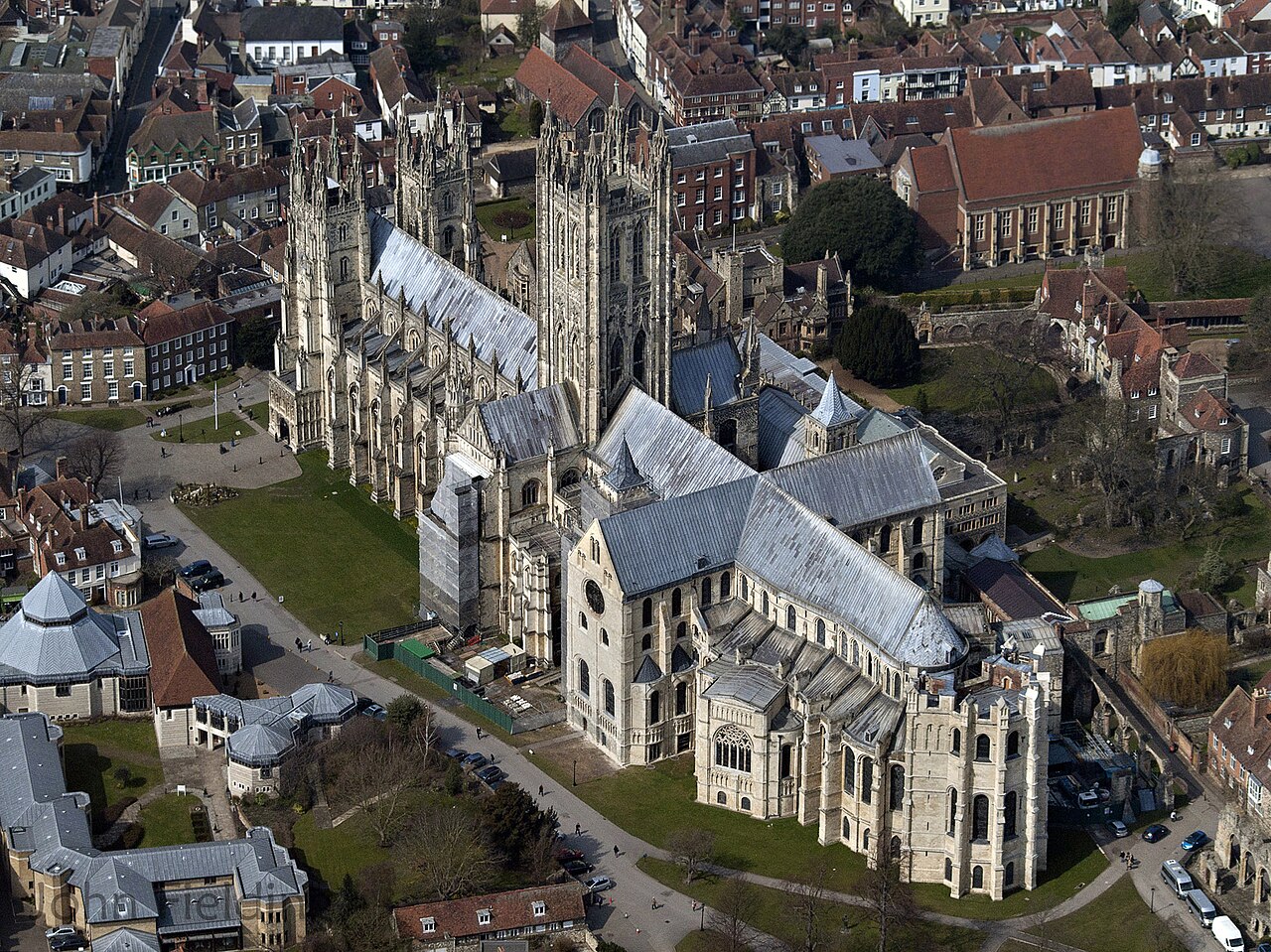
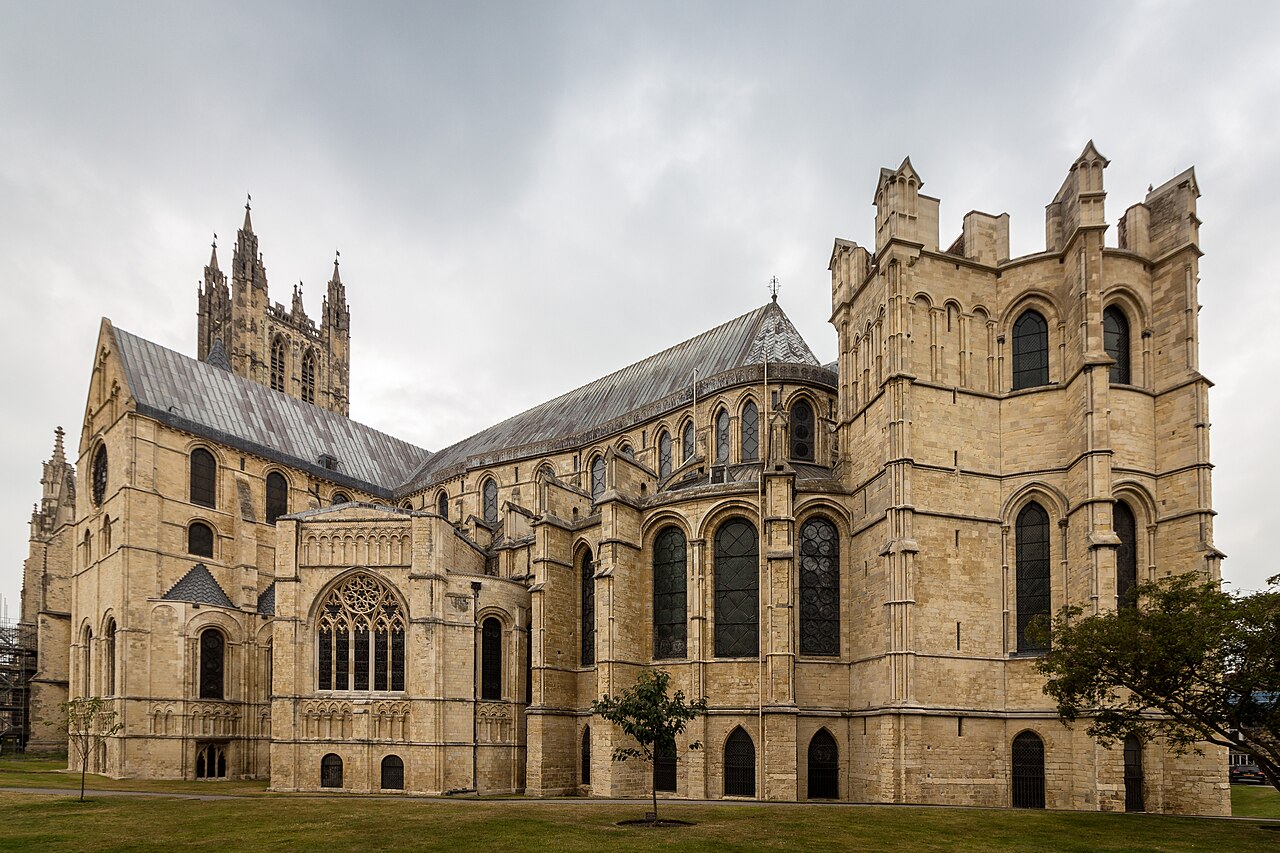
Canterbury Cathedral has never been a static structure. The original Anglo-Saxon church, which 1993 excavations revealed was built across a Roman road with a nave, possibly a narthex, and side-chapels, was replaced in the 9th or 10th century by a larger structure measuring 161 by 75 feet with a squared west end. A devastating fire in 1067, a year after the Norman Conquest, destroyed the structure. Archbishop Lanfranc, the first Norman archbishop, cleared the ruins and rebuilt between 1070 and 1077, modeling the design closely on the Abbey of Saint-Étienne in Caen and importing stone from France. The new cruciform church featured a nine-bay aisled nave, a pair of towers at the west end, aisleless transepts with apsidal chapels, a low crossing tower, and a short quire ending in three apses. Under Lanfranc's successor Anselm, Prior Ernulf demolished the inadequate east end in 1096 and replaced it with an eastern arm 198 feet long, doubling the length of the cathedral. After a fire in September 1174, the quire was severely damaged, and the master-mason William of Sens rebuilt it in the new Gothic style with pointed arches, rib vaulting, and flying buttresses. The Norman nave and transepts finally gave way in the late fourteenth century to the present structures.
Becket's Blood and the Pilgrim Tide
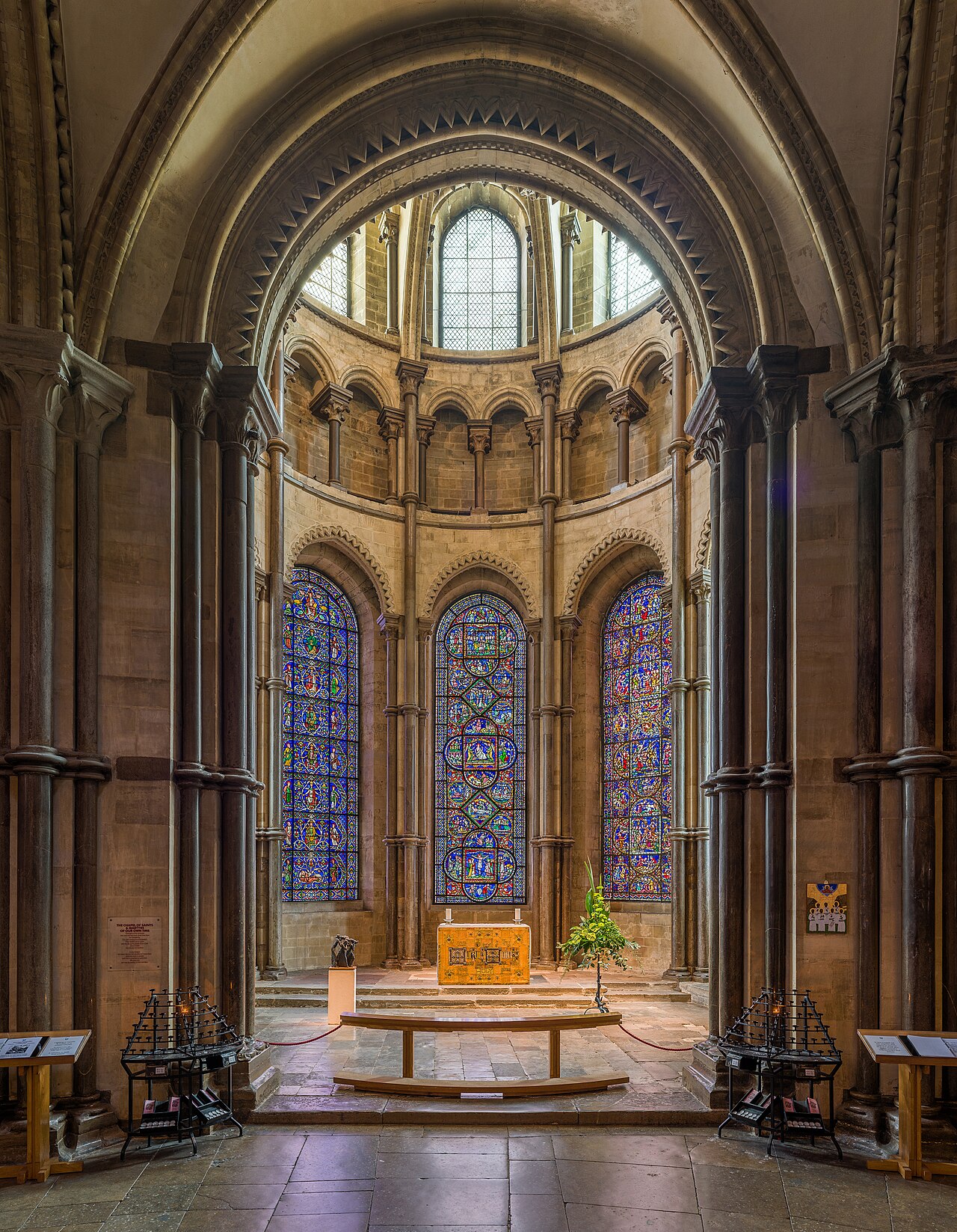
On Tuesday 29 December 1170, Archbishop Thomas Becket was murdered in the north-west transept by knights of King Henry II. The king had frequent conflicts with the strong-willed Becket and is said to have exclaimed in frustration, 'Will no one rid me of this turbulent priest?' Four knights took it literally and murdered Becket in his own cathedral. After the Anglo-Saxon Ælfheah in 1012, Becket was the second Archbishop of Canterbury to be murdered. The posthumous veneration of Becket transformed the cathedral into a place of pilgrimage, necessitating both expansion of the building and an increase in wealth via revenues from pilgrims. In 1180–1184, the present Trinity Chapel was constructed, a broad extension with an ambulatory designed to house the shrine of St Thomas Becket. A further circular chapel, known as the 'Corona' or 'Becket's Crown', housed further relics, widely believed to have included the top of his skull. The shrine was placed directly above Becket's original tomb in the crypt. A marble plinth, raised on columns, supported what an early visitor, Walter of Coventry, described as 'a coffin wonderfully wrought of gold and silver, and marvellously adorned with precious gems.'
Monastic Heart, Ecclesiastical Seat
Before the English Reformation, Canterbury Cathedral was not merely the seat of the archbishop but the spiritual center of a Benedictine monastic community known as the Priory of Christ Church, Canterbury. During the reforms of Dunstan, archbishop from 960 until his death in 988, a Benedictine abbey named Christ Church Priory was added to the cathedral. The formal establishment as a monastery seems to date only to around 997, and the community only became fully monastic from Lanfranc's time onwards, with monastic constitutions addressed by him to Prior Henry. Dunstan was buried on the south side of the high altar. The cathedral thus functioned as both the seat of the archbishop of Canterbury—the spiritual leader of the Church of England and symbolic head of the worldwide Anglican Communion—and the mother house of a working monastic community. Its formal title, the Cathedral and Metropolitical Church of Christ, Canterbury, reflects this dual identity.
Common Misconceptions (Editorial)
Many people assume Canterbury Cathedral is purely a Gothic structure, but the facts show it also incorporates significant Norman architecture, as its listed style is "Norman and Gothic." Another common misconception is that the cathedral was always solely a seat for the archbishop; in fact, before the English Reformation, it was also part of a Benedictine monastic community known as the Priory of Christ Church, Canterbury.
Why It Matters (Editorial)
Canterbury Cathedral endures as a living monument to centuries of faith, conflict, and renewal, from its founding by Augustine in 597 to its rebuilding after the murder of Thomas Becket. It remains the spiritual heart of the Anglican Communion, drawing millions of pilgrims and visitors who seek to connect with the layered history of Christianity in England and the ongoing story of a tradition shaped by both tragedy and transformation.
Gallery
Frequently Asked Questions
Who is Canterbury Cathedral?
Canterbury Cathedral is the seat of the Archbishop of Canterbury, serving as the spiritual head of the Church of England and the symbolic figurehead of the global Anglican Communion. It sits in Canterbury, Kent, on grounds that have hosted Christian worship since 597, making it one of the oldest continuously used church sites in England.
What is Canterbury Cathedral's role in the Anglican world?
It functions as the mother church of the entire Anglican Communion, meaning every other Anglican church traces its spiritual lineage back to this single building. The Archbishop who occupies its throne carries both national religious authority in England and a symbolic leadership role across all Anglican provinces worldwide.
What is Canterbury Cathedral's most famous story arc?
In 1170, four knights entered the nave and killed Archbishop Thomas Becket on the cathedral's own floor, turning the building into one of medieval Europe's great pilgrimage destinations. The site of his murder still marks a focal point for visitors today, and the event reshaped the political relationship between the English crown and the church for generations.
How does Canterbury Cathedral's story end?
It doesn't—it is still active and standing. The cathedral continues to host daily worship, major Anglican ceremonies, and welcomes millions of visitors each year as part of a UNESCO World Heritage Site, with its Norman and Gothic architecture continuously maintained from the 6th century to the present.
Why is Canterbury Cathedral important?
Founded in 597, it is the oldest and most senior episcopal see in England, giving it a foundational place in the entire history of Western Christianity on the island. As both a living church and a World Heritage Site, it anchors the religious identity of the Church of England while preserving over fourteen centuries of architectural and cultural heritage.
More in Great Cathedrals 1-20
Spotted an error? Know more?
This is a living reference — every entry is fact-audited, and reader corrections feed straight into our audit queue. Suggest an edit · See this site's audit record